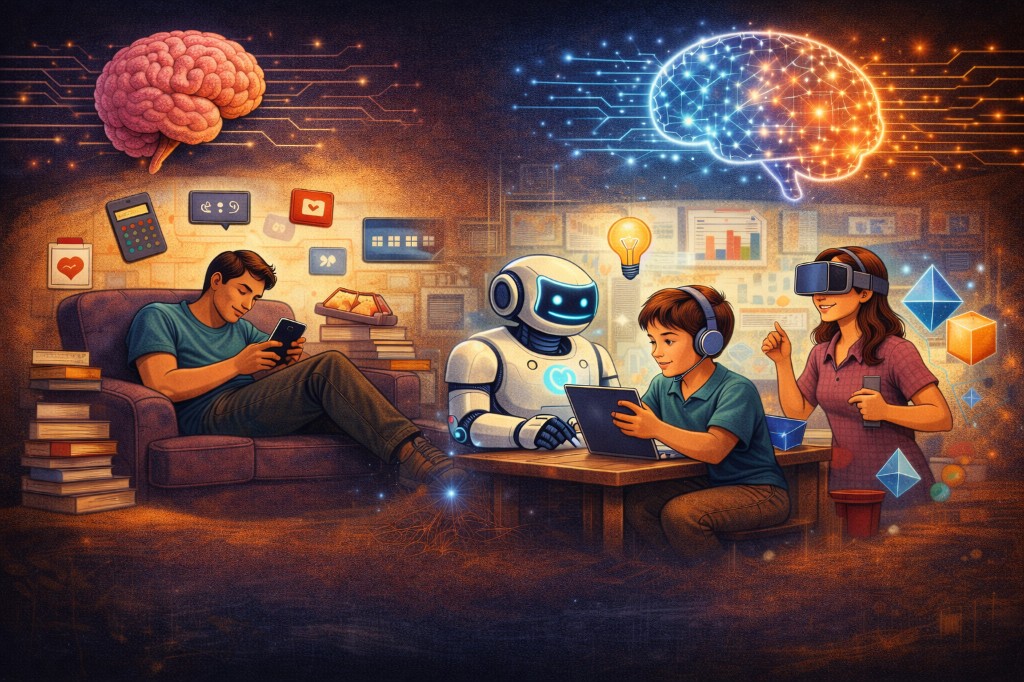
Something I always think about is how AI can affect the way we think. Will it eventually make us dumber?
Technology for the most part has always been a net benefit, but it comes with its own trade-offs. Contacts in your mobile means you never have to remember another phone number. Big calculations? Calculator or an Excel sheet. Bored? Watch a million shows on Netflix. Hungry? Order a pizza from Swiggy even if you shouldn't eat it. These are very clear benefits. But there are obvious costs too. Memory and the way we use our brains have been rewired. We've become more prone to immediate gratification. The ways our minds work may not be optimal because of this shift.
Our sentience is what makes us different from other species. Our ability to cooperate and build is what has brought us here. Our sheer curiosity and ingenuity. The idea that we can think our way out of a problem is the foundation of modern society. But as society shifts, the way we do things has to shift with it. I have a few thoughts on how we should be thinking about education and the incentives around how we learn.
How AI Can Actually Teach Us
My schooling took place mostly in the early 2000s and 2010s. Board and chalk, then whiteboard and marker, then a projector with visuals and a 35 to 45 minute class where a fixed course had to be taught. We had to learn Shakespeare, which I never really understood why. And I'll admit I don't fully know how schools operate today.
But I always thought the 35 minute lecture lacked nuance. A teacher cannot possibly explain a problem or concept properly to a class of 45 or 50 kids. There was no way that was an ideal situation. We did it because everybody did it.
When I came across ChatGPT, the first thought that came to me was: this is how education moves forward.
As a society we tend to create structures for how things should be done and expect everybody to follow. A classroom, finish the course material, tests, projects, exams. This feels like a very old way of teaching. Subjects evolve, our understanding evolves. Even if you bring computers into class instead of physical books, how do you change the actual way of learning so students don't feel intimidated asking questions or getting things wrong?
I had a learning disability and it showed up as a lack of interest in school. But I realised that learning is challenging and can be genuinely fun. I find it interesting to explore subjects now, well beyond my school and college years. Because I learn at my own pace, I don't have to answer to anyone, and my learning isn't subject to an arbitrary exam that decides whether I pass or fail based on how much I can recall in a fixed period of time. That cannot be the way we learn.
The Tools Are Already Here
The options for learning with AI are immense. It can be used for more than just cheating on assignments. It can actually be used to learn.
When I was younger, reading was tricky for me. But it wasn't optional. Today there are more ways to absorb the same idea, concept, or lesson. Can't understand a math question? Use Photomath and understand it through the answer. Struggle with reading? Use voice mode. Too shy to ask questions in class? Socratic by Google walks you through step by step.
I find reading papers on arXiv genuinely intimidating. But I need to do it to keep up with new breakthroughs in AI. So when I don't understand something, I query those docs on Claude or GPT. An even better tool I found was NotebookLM, where a document gets turned into a podcast you can just listen to. That is a bloody genius way to learn.
Some US schools have already introduced Khanmigo by Khan Academy, where teachers use the platform to tailor courses to individual students. Students can query and learn on their own. It helps teachers with lesson planning and progress reports. It helps students ask questions without the pressure of a classroom setting. It tracks how students are actually doing, so a teacher can quietly identify who needs more focus without singling anyone out. It can give students real critical thinking feedback, not just a grade. The platform can even flag when a student has copied from ChatGPT instead of putting in actual work.
Where This Is Going
The future of this technology is interactive and real time. As vision models get better, students will be able to interact with these platforms live. The platform will see what the student is doing, give them feedback while they are doing it, whether it's a geometry assignment or any live task. It will read the student's mood at that moment and adjust accordingly.
The way we used to learn is over. The fundamentals don't change. But the age of personalised learning is coming. The era of one question paper and marks will shift toward actually measuring how much a student understands a concept, not just whether they could memorise it for an exam. That should be exciting.